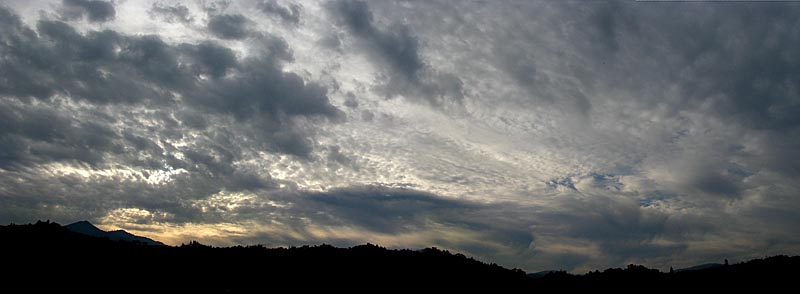
Showing posts with label sunset clouds. Show all posts
Sunday, February 4, 2018
A rather dry but interesting month......
Labels:
california coast,
california winter storms,
change of seasons,
stormy skies,
sunset clouds,
western skies,
western storm clouds
Wednesday, July 19, 2017
Rain has pretty much become history til late fall...
Never the less, an interesting month
One last gasp of rain, Thursday 6/8.
The afternoon before, you could see it coming, at least I could from my north-facing windows.
And after the rain passes thru....
6/16 Sunset!
6/19
We are thru about three days of what has been billed as a massive heat wave thanks to a hi pressure dome in the desert SW. One AM sunrise, some moisture from another system managed to sneak in, create some semblance of what photographers call 'popcorn skies' which got lit by rising sun red/yellow light.
What can I say but "MAH-VELOUS"!
Since then? Pretty boring, just blue skies from horizon to horizon.
I'll be watching the NWS forecast:
http://forecast.weather.gov/product.php?site=MTR&issuedby=MTR&product=AFD&format=CI&version=1&glossary=1
... in hopes of taking in some Marin Headlands fog.
Labels:
california coast,
california winter storms,
change of seasons,
stormy skies,
sunset,
sunset clouds,
western skies,
western storm clouds
Sunday, March 5, 2017
To write 'It's been a wild month!' would be an understatement!
The shot above reminds me of fireflies i enjoyed back east:
There were many interesting skies to behold! Pictures are worth many, many words, especially mine, so let's get right to it.
3/4 Sat
A quiet and rather sunny week, but forecast calls for 'scattered showers' over the weekend.
The daylight hours were what i have dubbed 'rainbow skies' - that is to say broken cloud cover, some sunlight, some rain, producing numerous partial and fast moving rainbows. I am happy to note that i will last longer than these, and am around and sentient enough to appreciate them.
I guess i must be constantly under 'scattered', because at 9 PM it's raining sideways - lightly so, but still 'sideways'.
The next AM there are signs it ain't over yet. I'll call this a mini-mammatus:
https://en.wikipedia.org/wiki/Mammatus_cloud
(lots of great images here!)
"Mammatus are most often associated with the anvil cloud and also severe thunderstorms. They often extend from the base of a cumulonimbus, but may also be found under altocumulus, altostratus, stratocumulus, and cirrus clouds, as well as volcanic ash clouds. In the United States, sky gazers may be most familiar with the very distinct and more common cumulonimbus mammatus. When occurring in cumulonimbus, mammatus are often indicative of a particularly strong storm or maybe even a tornadic storm".
The shot above was taken around 9AM.
By 10:30, there was hail!
I hope the rest of March is just as interesting as February was!
My Canon Powershot camera is always within quick reach!
The shot above was taken around 9AM.
By 10:30, there was hail!
I hope the rest of March is just as interesting as February was!
My Canon Powershot camera is always within quick reach!
Labels:
california coast,
california winter storms,
change of seasons,
Cirrus clouds,
mammatus clouds,
stormy skies,
sunset clouds,
western skies,
western storm clouds,
winter storms
Saturday, January 14, 2017
Be careful what you wish for -
It just might come true. We've been hoping for rain, and my, my, my, did we ever get it!
A few storms rolled thru in December, they started to put a big dent in the drought.
There were several nice sunsets:
12/12
12/25
A nice detail, just to right of center.
1/7
All week we've been listening to predictions of a whopper storm hitting us over the weekend, 1/7-1/9. It's 'sposed to be a once-every-25-years' event. Here's three images that show what's coming:
Always check this one out:
-------------------------
We are lucky to live in times with the technology we have - here are the the different types of sat imagery:
Needless to say there is incredible software that can crunch information and generate computerized predictions. It wasn't so long ago that all we had were rudimentary prediction tools and communications media, so people had pretty simple warnings, and disaster striking caught most flat-footed:
Galveston hurricane
Radio was a recent invention, only decades old.
"Starting in late 1894, Guglielmo Marconi began pursuing the idea of building a wireless telegraphy system based on Hertzian waves (radio). Marconi gained a patent on the system in 1896 and developed it into a commercial communication system over the next few years."
And 60 years before that:
California Megaflood: Lessons from a Forgotten Catastrophe
A 43-day storm that began in December 1861 put central and southern California underwater for up to six months, and it could happen again.
Saturday 1/7 started calmly enough... then about 10:30, a ferocious wind kicked in, the huge tree out my window 1/2 block away is writhing in the gusts. The rest of the weekend was constant rain.
It abated by nonday AM, but returned again on Mon. PM.
This rain has certainly soothed the drought in Nor. Cal., the drought has been declared officially over in the northern 40% of the state. but So. Cal hasn't been so lucky.
There were some excellent rainbows to be seen, but not in my neck of the woods - photographically, this storm was uninteresting for me.
So what havoc has this winter dealt our beaches and shoreline?
Here's an example:
If you look at a longer history in a geologic time frame, the Ca. coast has always been under attack, since the last ice age, when ocean waters receded. The ice age ended, oceans rose, waves carved the coastline we know now and love.
But it ain't over yet. I've walked many a mile along the beaches from SF to Half Moon Bay, i know well how soft and malleable this land is - VERY!
Once i was walking Drakes Beach at Pt Reyes w/ a friend who dared to walk right along the cliff wall, taking pictures. I joked that this might make a good TV ad for Leica cameras (which have a soundless shutter) - the beachcomber walks, trips the shutter a few times with some other kind of camera here and there, which makes that 'ca-chunka' sound. Then suddenly, the cliff gives way, buries him. A voice says "if only he'd been using a Leica..." (no sound vibration to disturb the cliff walls, shake anything loose.)
To wrap things up, here's an interesting story:
Labels:
california coast,
California drought,
california winter storms,
stormy skies,
sunset,
sunset clouds,
western skies,
winter storms
Sunday, December 4, 2016
An interesting month, yes indeed it 'twas...
We got some good doses of rain!


When it rains it pours - makes for interesting driving. The storm drain on the street outside my window:
Clogged! It's now a small lake! It made for some interesting driving:
Do you remember jumping into puddles when you were a kid?
This is the adult automotive equivalent. Don't be standing on that corner!
LINKS
Hope all these work for you.
Polar stratospheric cloud
Something i stumbled upon, looks a few i have seen:
Polar stratospheric clouds or PSCs, also known as nacreous clouds, are clouds in the winter polar stratosphere at altitudes of 15,000–25,000 meters
A most devoted sky watcher reported:
where does the term nacreous come from?
It looks a lot like an abalone shell, commonly found on the the No. Ca. coast.
----------------------------------------------
Plenty of talk about drought:
Megadroughts, rather scientific
"They are suspected of playing a primary role in the collapse of several pre-industrial civilizations, including the Anasazi of the North American Southwest, the Khmer Empire of Cambodia, the Mayan of Mesoamerica, the Tiwanaku of Bolivia, and the Yuan Dynasty of China."
"When megadroughts occur, lakes dry up and trees and other plants grow in the dry lake beds. When the drought ends the lakes refill, when this happens the trees are submerged and die. In some locations these trees have remained preserved and can be studied giving accurate radio-carbon dates, and the tree rings of the same long dead trees can be studied. Such trees have been found in Mono and Tenaya lakes in California, Lake Bosumtwi in Ghana; and various other lakes."
"During a 200-year mega drought in the Sierra Nevada that lasted from the 9th and 12th centuries, trees would grow on newly exposed shoreline at Fallen Leaf Lake, then as the lake grew once again, the trees were preserved under cold water."
------------------
Persistent drought in North America:
a climate modeling and paleoclimate perspective
Richard Seager
Lamont-Doherty Earth Observatory of Columbia University
A millennium of North American droughts and pluvials
A farm during the Dust Bowl. This one is in South Dakota during May 1936.
For year after year across vast areas of North America rainfall was low. Summers were parched and the heat excessive. Plants withered and sand dunes moved freely across a formerly green landscape. Human settlements had to be abandoned and populations migrated, forcing social change. By some measures the drought lasted more than a decade.
No, this is not a description of the Dust Bowl drought of the 1930s but of the truly severe drought of the late thirteenth century, which coincided with the end of the Anasazi civilization. It could just as easily describe the severe drought of the late sixteenth century. Or it could describe the droughts of the mid-Holocene which so taxed the indigenous peoples of the Great Plains."
'A tree stump in Mono Lake in California that grew during an ancient drought and was submerged when wet years returned. Scott Stine used carbon dating of stumps to recreate the drought history of the area'
Photo - Scott Stine
Another excellent weather blog for those on the north west coast - CA, OR, & Washington:
http://www.nytimes.com/2016/10/23/magazine/why-isnt-the-us-better-at-predicting-extreme-weather.html
Even with drought, a California river will begin flowing year-round for the first time in 60 years
A decade ago, environmentalists and the federal government agreed to revive a 150-mile stretch of California's second-longest river, an ambitious effort aimed at allowing salmon again to swim up to the Sierra Nevada foothills to spawn.
A major milestone is expected by the end of the month, when the U.S. Bureau of Reclamation says the stretch of the San Joaquin River will be flowing year-round for the first time in more than 60 years.
Some news is good:
"We're currently at over 17 inches of liquid for October and November combined—that's 200 percent above normal—and haven't had that high of a reading since 1985-86.
"It has really been a pretty good start to the water year," Kurth, who work's in the NOAA's Sacramento office, said. "We had a really wet October. We had a dry start to November, but last week things changed."
----------------------------
Fall snow, rains have 'satisfied the drought debt' in Northern Sierra Nevada, climatologist says
In the days leading up to Thanksgiving, concerns over dry conditions were quickly dispatched when more than two feet of snow dropped around the lake in just two days.
Let's see what happens - you can tell from al the links above, there is much room for discussion!
Labels:
california coast,
California drought,
california winter storms,
stormy skies,
sunset,
sunset clouds,
west coast drought,
western storm clouds
Subscribe to:
Posts (Atom)